

Cultivating Dracaena trifasciata (commonly known as the Snake Plant or Mother-in-Law’s Tongue) requires an architectural understanding of the plant’s structural properties. In my residential consulting work across the United States, United Kingdom, Canada, and Australia, I frequently observe homeowners treating this resilient succulent like a standard tropical houseplant. This systematic error almost always leads to soil compaction, root rot, and structural leaf failure.
To maintain a crisp, upright snake plant that actively filters indoor air toxins while anchoring your interior design, you must understand its specialized metabolic needs. This technical care manual provides the exact soil, light, and hydraulic parameters required to keep this architectural specimen thriving through 2026 and beyond.
The Snake Plant Technical Optimization Matrix
To ensure structural structural integrity, align your home or office setup with these target indoor metrics:
| Operational Parameter | Residential Target Level | Diagnostic Measurement Method |
| Light Tolerance | 50 to 300 foot-candles (Highly Adaptable) | Ambient light meter analysis |
| Hydraulic Frequency | Every 14 to 30 days (Dry Down Paradigm) | Substrate moisture probe check (Must hit 0%) |
| Substrate Porosity | 50% Succulent Soil, 30% Perlite, 20% Coarse Sand | High-drainage physical texture audit |
| Temperature Range | 60 to 85°F (15 to 29°C) | Digital room thermostat tracking |
1. Light Physics: Balancing Growth with Location Flexibility
One of the greatest biological advantages of Dracaena trifasciata is its capacity for CAM photosynthesis (Crassulacean Acid Metabolism). This evolutionary trait allows the plant to close its stomata during the hot day to conserve water and open them at night to absorb carbon dioxide. Because of this high-efficiency system, it tolerates low-light environments far better than other foliage.
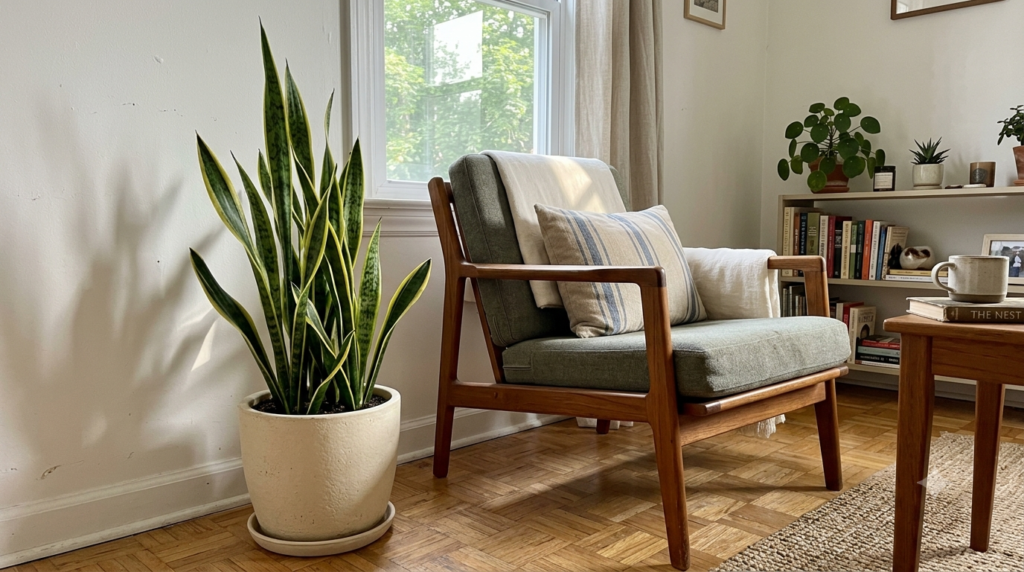
However, “tolerating” low light does not mean thriving in it. If placed in a dark, north-facing room or a windowless office cubicle, growth will stall, and the striking yellow variegation along the margins will fade to a dull green. For optimal, rapid growth, position your snake plant in bright, indirect light near an east- or west-facing window. Rotate the pot $180^{\circ}$ every two weeks to prevent phototropic leaning and ensure the vertical leaves grow perfectly straight.
2. Hydraulic Management: The Dry-Down Principle
If you water a snake plant on a weekly calendar schedule, you are actively killing it. These plants store massive amounts of water inside their thick, fibrous leaf blades and subterranean rhizomes (fleshy underground stems).
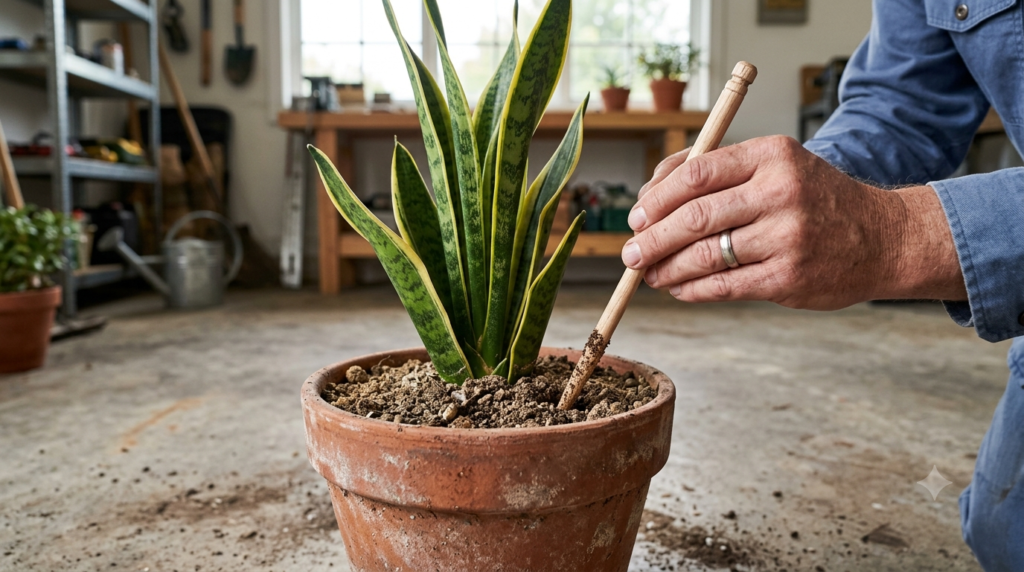
The Mandatory Watering Verification Process:
- Zero-Moisture Target: Never add water unless the substrate is $100\%$ dry from the surface down to the bottom of the root ball. This usually equates to once every 14 to 20 days in the summer, and every 30 days during winter dormancy.
- Saturate and Flush: When watering, drench the soil thoroughly until water discharges from the bottom drainage holes. This ensures the deep root structures receive hydration.
- Evacuate the Saucer: Never let the pot sit in standing water. Empty the drainage saucer immediately to prevent moisture from wicking back into the soil and triggering fungal root decay.
3. Substrate Engineering & Pot selection
Standard commercial potting soil holds water like a sponge, which suffocates the snake plant’s delicate root system. To prevent structural collapse, you must utilize a rapid-draining, highly porous substrate.
We recommend a structural blend composed of 50% commercial cactus/succulent mix, 30% perlite, and 20% coarse horticultural sand. This aggregate makeup ensures that water passes through the medium within seconds, leaving air pockets behind for root respiration.
When selecting housing, prioritize unglazed terracotta or heavy ceramic pots with large drainage holes. Terracotta is naturally porous, allowing excess soil moisture to evaporate through the walls of the pot. Avoid plastic or metal containers without drainage, as they trap toxic moisture pockets at the base of the root system.
4. Rhizome Expansion: When and How to Repot
Snake plants prefer to be slightly root-bound. The pressure of the roots against the walls of the pot actually stimulates the rhizome to produce fresh vertical pups. Repotting should only occur every 2 to 3 years during the spring season.
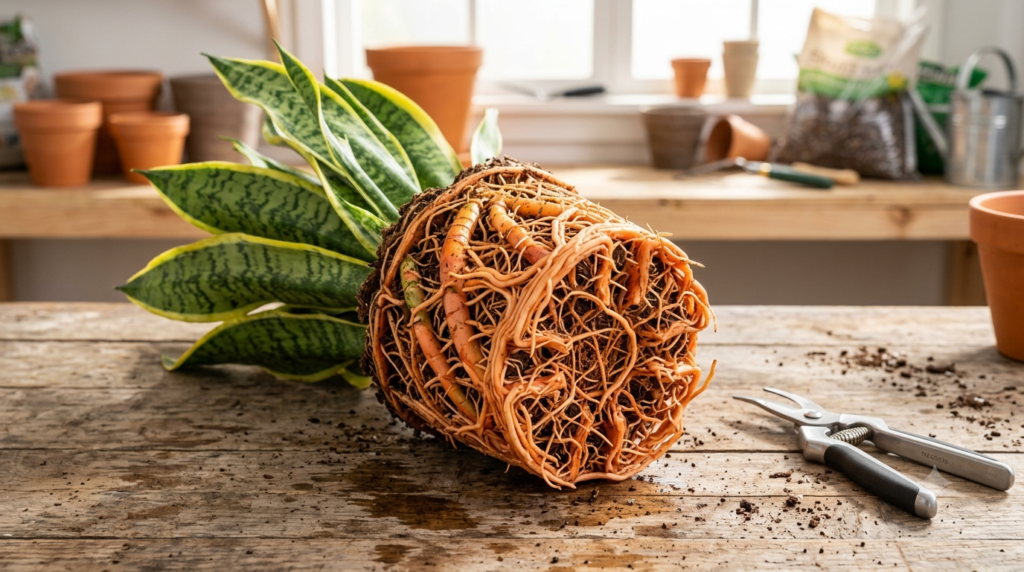
The Systematic Repotting Sequence:
- Step 1: Extract Carefully: Slide the root ball out of the pot. If it is stuck, gently tap the sides of the container to loosen the soil structure.
- Step 2: Inspect the Core: Examine the thick, orange-colored rhizomes. Ensure they are firm and free of soft, water-logged rot spots.
- Step 3: Size Up Minimally: Select a replacement pot that is only 1 to 2 inches larger in diameter than the old one. Going too large introduces excess soil that retains unwanted moisture.
- Step 4: Set the Depth: Position the plant so it sits at the exact same depth as it did previously. Burying the base of the leaves too deep causes immediate crown rot.
5. Propagation Protocols: Expanding Your Collection
Propagating Dracaena trifasciata is a highly reliable process when executed via two distinct technical methods:
Method A: Rhizome Division (Preserves Variegation)
If your parent plant has multiple thick clusters of leaves, un-pot the plant and identify the thick connection bars (rhizomes) joining them. Using a sterilized knife, slice through the rhizome, ensuring each section retains its own root system. Pot each division immediately into dry succulent soil.
Method B: Leaf Cuttings (May Revert to Green)
Cut a healthy, mature leaf at the base. Segment it into 4-inch sections, carefully marking the proximal end (the bottom). Let the cuttings dry for 48 hours until the wounds form a protective callus. Insert the bottom end 1 inch deep into a moist sand-and-perlite mix. Keep in bright indirect light; root structures and new pups will emerge from the base within 6 to 8 weeks.
Diagnostic Troubleshooting for Common Systemic Failures
- Symptom: Wrinkled, Puckered Leaves: The plant has completely exhausted its internal water reserves. This is a sign of extreme underwatering. Administer a thorough, deep watering cycle immediately.
- Symptom: Mushy, Leaning Leaf Bases: This is a critical stage of root rot caused by chronic overwatering. Remove the plant from its substrate, slice away all black, decaying roots, treat the remaining healthy tissue with sulfur powder, and repot into fresh, completely dry soil.
- Symptom: Brown, Crispy Leaf Tips: Usually caused by chlorine or fluoride accumulation from municipal tap water, or severe atmospheric dryness from HVAC units. Trim the dead tips neatly using an angular cut to preserve the natural leaf geometry, and switch to distilled or rainwater.
Frequently Asked Questions
Is the snake plant toxic to household pets?
Yes. Dracaena trifasciata contains chemical compounds called saponins, which are toxic to dogs and cats. If ingested, it can cause gastrointestinal distress, drooling, and mild lethargy. Position your pots on elevated tables or plant stands out of reach of animals.
Why is my snake plant growing so slowly?
Slow growth is typically caused by severe light deprivation or a lack of nutrients during the active summer cycle. Move the plant closer to an indirect light source and apply a balanced, low-nitrogen liquid fertilizer diluted to quarter-strength once in late spring.
Can I grow snake plants in a bathroom with zero windows?
No. While they handle high humidity well, no plant can survive long-term without photons. A windowless bathroom will cause the plant to stretch, weaken, and eventually rot. Install an auxiliary LED grow bulb if natural light is absent.
Technical Conclusion
The longevity of a snake plant relies directly on minimal, highly intentional intervention. By engineering a high-porosity succulent substrate mix, respecting its native dry-down moisture requirements, and protecting its root crown from stagnant water, you ensure its geometric leaves remain rigid and healthy. Treat this tough succulent with structural awareness, avoid calendar-based watering traps, and let its slow, steady biological cycle unfold naturally.